

Peter Brown in the media
Art supports a worthy cause
The Gisborne Herald, Saturday, June 4, 2005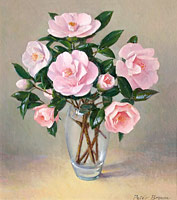 COPPER sculptures, contemporary jewellery and photography are just a few of the artistic mediums that will feature in the Chelsea Art Exhibition next weekend. COPPER sculptures, contemporary jewellery and photography are just a few of the artistic mediums that will feature in the Chelsea Art Exhibition next weekend.The biennial exhibition, organised by Friends of Chelsea, gives Gisborne artists the opportunity to show their work collectively and support a worthy cause. The contributing artists will donate 30% of the proceeds of any pieces sold to Chelsea Hospital's respite care service. Friends of Chelsea chairwoman Anne Gordon said the respite care service survived entirely on fundraising projects. "We are so grateful to the artists who have kindly donated their work. It would not be possible without them," she said. |
The Gisborne community had been extremely supportive of the past three Chelsea Art Exhibitions, Mrs Gordon said, and she hoped for a similar response this time around. Featuring artists are Peter Brown, Gavin Smith, Adrian Cave, Roger Shanks, Christina King, Mary Briant, Peggy Ericson, Anne Alderlieste, Harriet Sherriff, Kate Hathaway, Tessa Chrisp, Erika Holden, Ro Timms, Glenda Gibbs, Elm Thorpe and Helena Andersson. Their works cover a range of mediums including oil paint, watercolours, photography, stainless steel and copper sculpture, mosaic mirrors, earthenware clay wallhangings and contemporary jewellery. The exhibition will be at Lawson Field Theatre. An opening night, with refreshments and nibbles, will be held on Friday June 10, starting at 5.30pm. Tickets are $15 and are available from Chelsea Hospital or And gift shop on Gladstone Road. The exhibition will also be open to the public on June 11 and 12, between 10am and 4pm, with a $5 entry fee. |
Rutland times revisited
New Zealand Herald, Wednesday, December 8, 2004The weather was squally on Saturday, but that didn’t dampen the celebratory mood of 150 people at a book launch. The launch of We Learnt To See: Elam’s Rutland Group 1935–58 is the culmination of a weighty project by former Auckland Museum Research librarians Ian Thwaites and Rie Fletcher, and it is completely sold out.
Two years ago, Thwaites and Fletcher put together the earlier stages of their project, Rutland Group Revisited, an exhibition at Kinder House of works by the group, named after the Rutland St. building which housed the original Elam Art School.
The group was created at the behest of Elam director A.J.C. Fisher, with the aim of raising the standard of art in Auckland. Up to 35 former students met monthly to appraise each other’s work and it is considered a significant period in the city’s art history.
For the past two years, Thwaites and Fletcher have been tracking down names, checking records and interviewing group members.
Without any funding, they have self-published We Learnt To See with 162 copies at $120 each pre-sold to members of the group, their families and some institutions such as public libraries.
The book covers the Rutland Group and 350 associated artists, reviewers, dealers and art historians, as well as substantial biographical essays and a review of other art groups active during approximately the same period.
Saturday’s launch at St. John’s School in Meadowbank included a walk to the graveside of Dr. John Elam, who founded – with a £10,000 bequest – what is now Auckland University’s School of Fine Arts.
Rutland Group supporters, Elam head professor Michael Dunn and artist Don Binney spoke of what it was like to work at Elam and told anecdotes about some of the featured artists.
The oldest Rutlander present, 96-year-old Ruth Coyle made it to the graveside. “Don likened (Dr. Elam’s bequest) to a tree with strong roots suggesting good leaves and fruit,” said Fletcher.
- Linda Herrick
Cancer can't quiet artist's calling
The Gisborne Herald, Thursday, August 19, 2004SIXTY years ago Royal Air Force navigator Peter Brown, aged just 22, was shot down over Holland and bundled off to a German prisoner of war camp where he spent the last two years of the Second World War.
Before his escape, Brown decided if he became a free man again he would dedicate the rest of his life to working as an artist.
He did.
But even life as an artist, living in a leafy Gisborne suburb and watching his children grow into adulthood, has not been without its dangers. Brown, now 83, has just emerged from a tussle with cancer that nearly finished what the war began.
Asked what he wants to do as his health slowly improves, Brown echoes the thought that drove him all those decades ago. He wants to get back into his art.
And there is plenty of demand for it.
Brown's work was last year an important part of an Auckland exhibition of works by surviving members of the Rutland Group – what has been described as a "radical" artists' collective – made up largely of graduates of the Elam School of Art who met regularly from 1935 to 1958.
He will again feature large in a limited edition history of the Rutland Group, soon to be published by Auckland Museum historians.
And he is this month showing work in a group show celebrating the 125th birthday of his long-time dealer, Wellington's McGregor Wright Art Gallery.
Showing alongside 14 other McGregor Wright artists, Brown has five recent paintings in the exhibition, which opened on August 8.
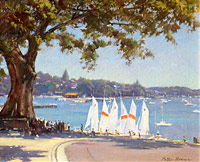 Exhibiting the realism typical of his work, the pieces include a vibrant summer scene of Sydney's Watsons Bay – captured when he recently visited his daughter in Australia -- a South Island vista along the autumn-clad Clutha River, and still lifes including a pretty depiction of lilacs, plus a work bursting with the aroma of plump, ripe peaches.
Brown says these are the types of works that had been in demand since his McGregor Wright dealer, Gordon Cooksley, first urged him to join his stable of artists some 30 years ago.
Since his illness, though, he says he may get a little more self-indulgent by spending more time on his first love – portraiture.
"You sometimes have to spend days with a subject to get it just right, which is a lot of ask of someone," he says. "Still, portraits have always been my first love."
That is clear from the display of paintings and conte works positioned throughout the Whataupoko villa he and wife Catherine have occupied in the nearly 25 years since they moved to Gisborne from Hawke's Bay.
Most are portraits.
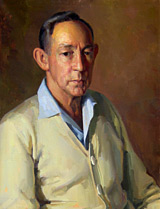 And most striking is the familial similarities in the works. The artist's own self-portrait mirrors a 1960s image he painted of his late father. A conte drawing of Catherine as a younger woman is the spitting image of a portait of her mother, hanging on the opposite wall.
Whatever he creates he admits his output – like editions of the Rutland book which celebrates the group members' assertion that "without drawing, there is no art" – will be limited.
In the nearly six decades since he graduated from Elam he has traditionally produced 30-to-40 paintings a year. Now, he says, he would be more than happy to put out a dozen.
That, he says, is partly down to the passage of time, partly because he gives each painting more consideration, and partly because he is still suffering the effects of the cancer that nearly put paid to his career.
Meanwhile, behind Brown's vine-draped villa the huge garage that houses his studio is beckoning. And he is looking forward to getting back into life's other pleasures, like pitching horseshoes, a game that, until recent months, he enjoyed on a weekly basis.
Catherine Brown says she doesn't really care what he does. She just feels lucky she still has him.
- Kristine Walsh

